
Biggest release to date brings a redesigned interface, full visibility across every storage device, and an S3 endpoint that lets applications write to the archive whatever storage sits behind it
Gibraltar, October 8, 2026 – SFS Media today announced the release of SF-Archive version 3, the most significant update to its enterprise archive and storage management platform since launch.
Version 3 is built around a single idea: an archive should be simple to operate and should never dictate how the rest of the facility works. The release introduces a completely redesigned user interface, real-time visibility into the status of every part of the archive infrastructure, and a native S3 interface that allows any application to write to the archive without needing to know what storage layer sits behind it.
An interface built for daily operations
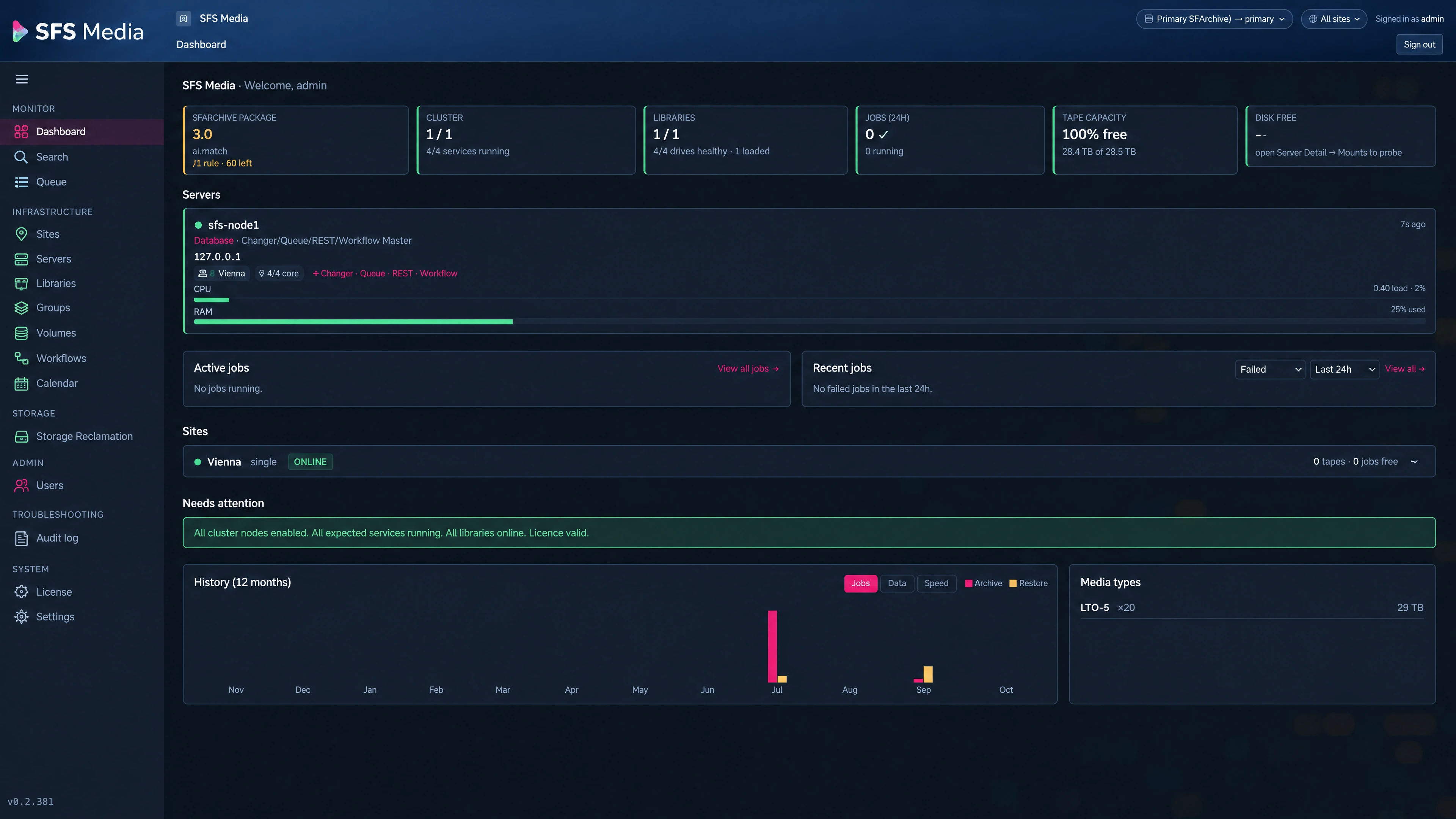
The new interface puts the information that operators actually need on the first screen they see. Archive and restore jobs, queues, throughput and system health are laid out clearly, and routine tasks that previously took several steps now take one. Teams that work with the archive all day spend less time navigating and more time working.
Full status across every device
SF-Archive version 3 gives a live view of all storage in the environment: tape libraries, drives, disk, object storage and cloud tiers, in one place. Operators can see which drives are in use, which volumes need attention, and what is happening at any moment. Where a device or a job can be restarted, that can be done directly from the same screen, without switching to another tool or calling in support.
S3 in, anything out
The most far-reaching change in version 3 is that SF-Archive can now present itself as an S3 endpoint. Any MAM, PAM, automation system or in-house tool that speaks S3 can write to and read from the archive directly, with no custom integration work. Behind that endpoint, SF-Archive continues to manage the content across LTO, disk, object storage or public cloud, applying the tiering rules the customer defines.
For broadcasters, this means the choice of archive media becomes a purely operational and financial decision rather than an integration project. Storage technology can be changed, added or replaced without touching the applications that depend on it.
Based on customer feedback
“Version 3 is the release our customers wrote for us,” said Mark Bouwensch, CEO and co-founder of SFS Media. “Nearly everything in it started as a request from someone running an archive day in, day out. The S3 endpoint is the piece I am most pleased with, because it takes an argument off the table. Teams no longer have to choose their archive technology based on what their MAM happens to support. They write to S3, and we take care of the rest, on whatever media makes sense for them.”
Endemol Shine Nederland took part in the beta programme for version 3. “The complete overview is what stands out for me,” said Guido Zoon, Technical Coordinator Post Production at Endemol Shine Nederland. “One screen, and I can see the status of every storage device we have. If something needs a restart and it can be restarted, I can do it right there. That is a different way of working from having to dig around to find out what is going on.”
Availability
SF-Archive version 3 is available now for new deployments and as an upgrade for existing customers. As with every SFS Media release, pricing is based on functionality, not on the amount of content stored. There are no capacity fees.